Our Word Notation Piano System helps students learn piano without reading traditional sheet music. Instead of relying on complex notation symbols, this method uses simple letter-based note guides and octave graphs that make piano learning faster, easier, and more intuitive for beginners and experienced players alike.
This unique system was developed exclusively for The Very Best Piano Instruction and allows students to play songs more quickly while reducing the frustration often caused by standard sheet music.
What Is Word Notation?
Word Notation displays notes in letter form so students can immediately identify what to play without needing years of music-reading training. This allows beginners to start learning songs right away while still building real piano skills.
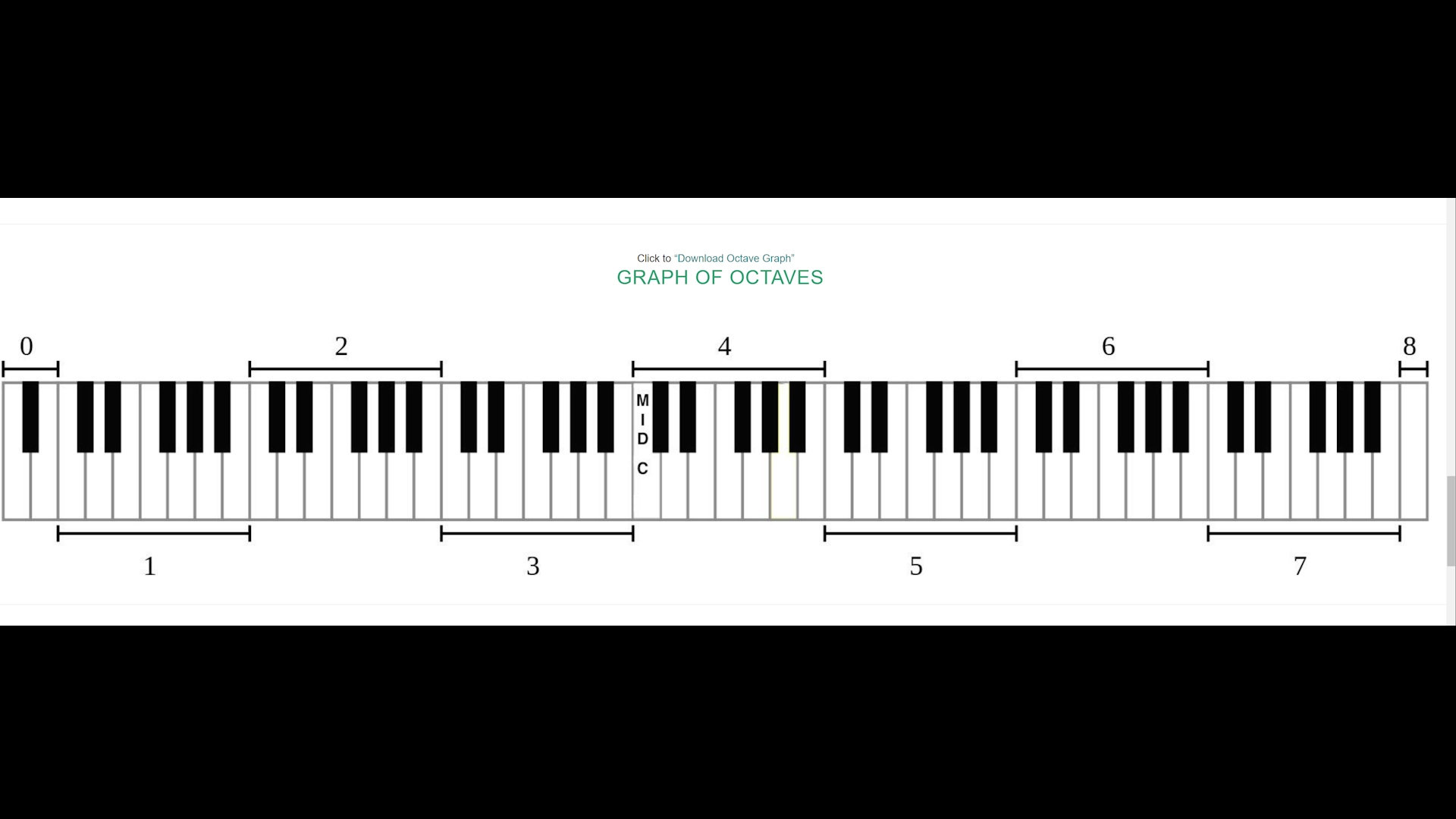
In addition to sheet music, we provide the notes written out in letter form on a Microsoft Word graph developed exclusively for this instructional series. The example below walks through the opening of Sound of Music — once you understand the layout, you can read along with any song on the site.
Watch the full video walk-through below to see exactly how the Word Notation works:
Prefer to read along? View the written transcription of the video for a step-by-step reference.
How the Octave Graph Works
The octave graph piano method is built on a simple grid: 4 rows and 20 columns that follow each section of a song exactly as it is played in the video parts. (The beginning and ending of each part on the video overlap by approximately one second, but the notation does not.)
Reading the Four Rows
Each of the 4 rows has a specific job. Read top to bottom:
-
Row 1 · Top
Right-Hand Octave
Shown in green. Tells you which octave the next right-hand note is played in.
-
Row 2
Right Hand
Shown in black. The letters you play with your right hand, in order, column by column.
-
Row 3
Left Hand
Shown in blue. The letters you play with your left hand, aligned vertically with the right-hand row.
-
Row 4 · Bottom
Left-Hand Octave
Shown in green. Tells you which octave the next left-hand note is played in.
Notation Key — Quick Reference
- E Note held longer (underlined letter)
- E Held for an extra beat (thicker underline)
- E Note played faster (red letter)
- CEG Notes played together as a chord (dark red, italic)
- CEG Notes played separately in sequence (light red, italic)
- E² Fingering — small number upper-right of the letter
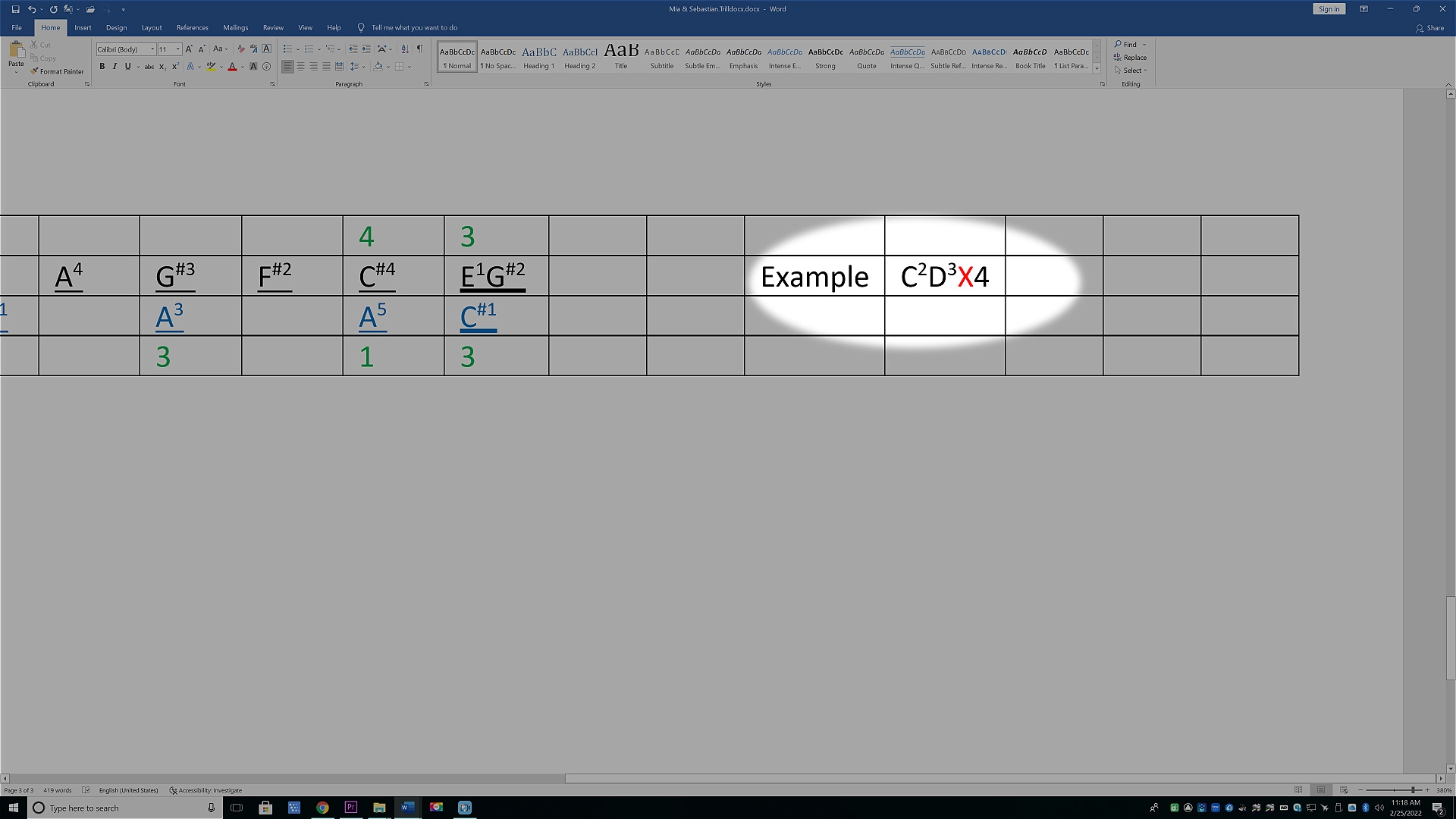
- EF ×4 Trill — two notes repeated, times-sign shows the count
- 4 Octave number (1–7, Middle C = 4)
Note: the first-column labels (Octave, Right Hand, Left Hand, Octave) are shown in the example below for training purposes only — they are not included on the rest of the Word Notation documents. The letter C that appears above the rhythm symbols is also only an example; it could be any letter in the scale.
Understanding Octaves
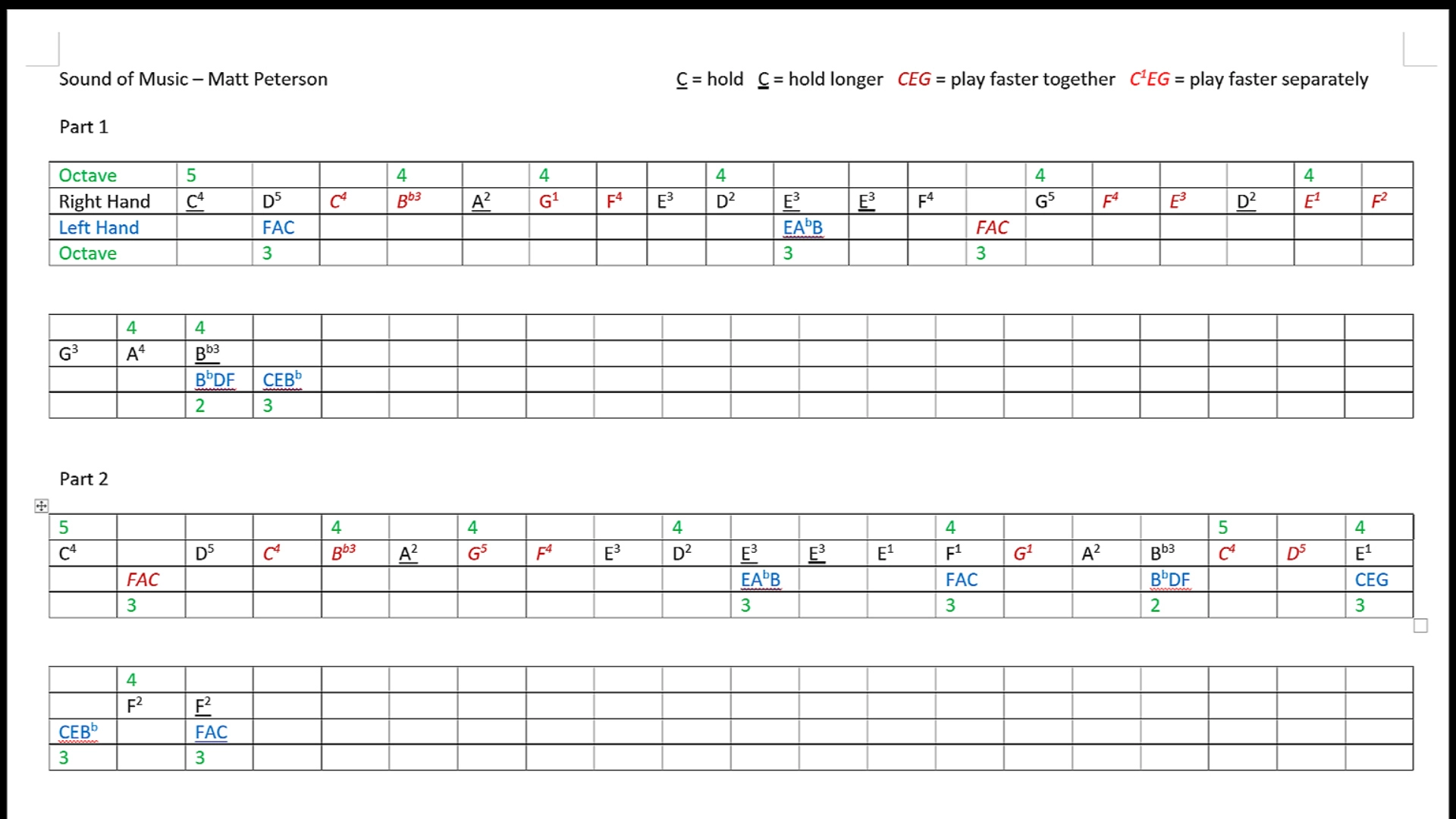
The octaves run from C to C. On an 88-key piano there are seven C-to-C octaves, with an extra two notes (A and B) at the very low end. The lowest C-to-C is octave 1, the highest is octave 7, and Middle C — which we specifically mark on the keyboard — is octave 4.
To keep the notation uncluttered we do not mark the octave of every note, only the ones needed to guide you through the piece. The octave is marked by whatever the most-left finger is playing. To see this clearly, watch the video in slow motion and pause while following along with the Word Notation. With a little practice this reading becomes second nature. Click here for the full Octave Graph.
Notes Played Together vs. Separately
When two or more letters appear next to each other, the color tells you whether to play them as a chord or in sequence:
- Dark red, italicized — the notes are played together as a chord (for example, column 14 in the Sound of Music example above).
- Light red, italicized — the notes are played separately, one after the other.
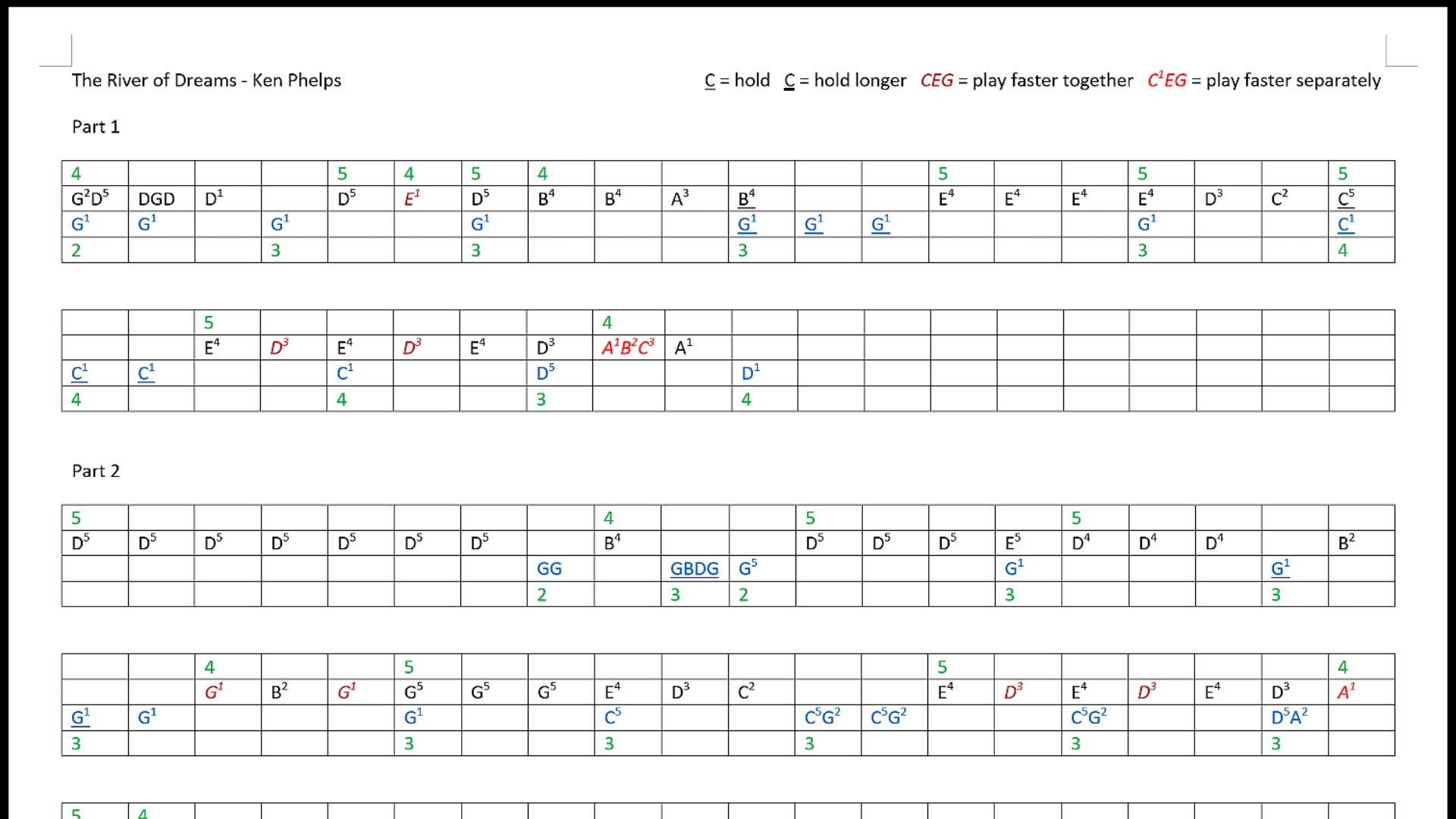
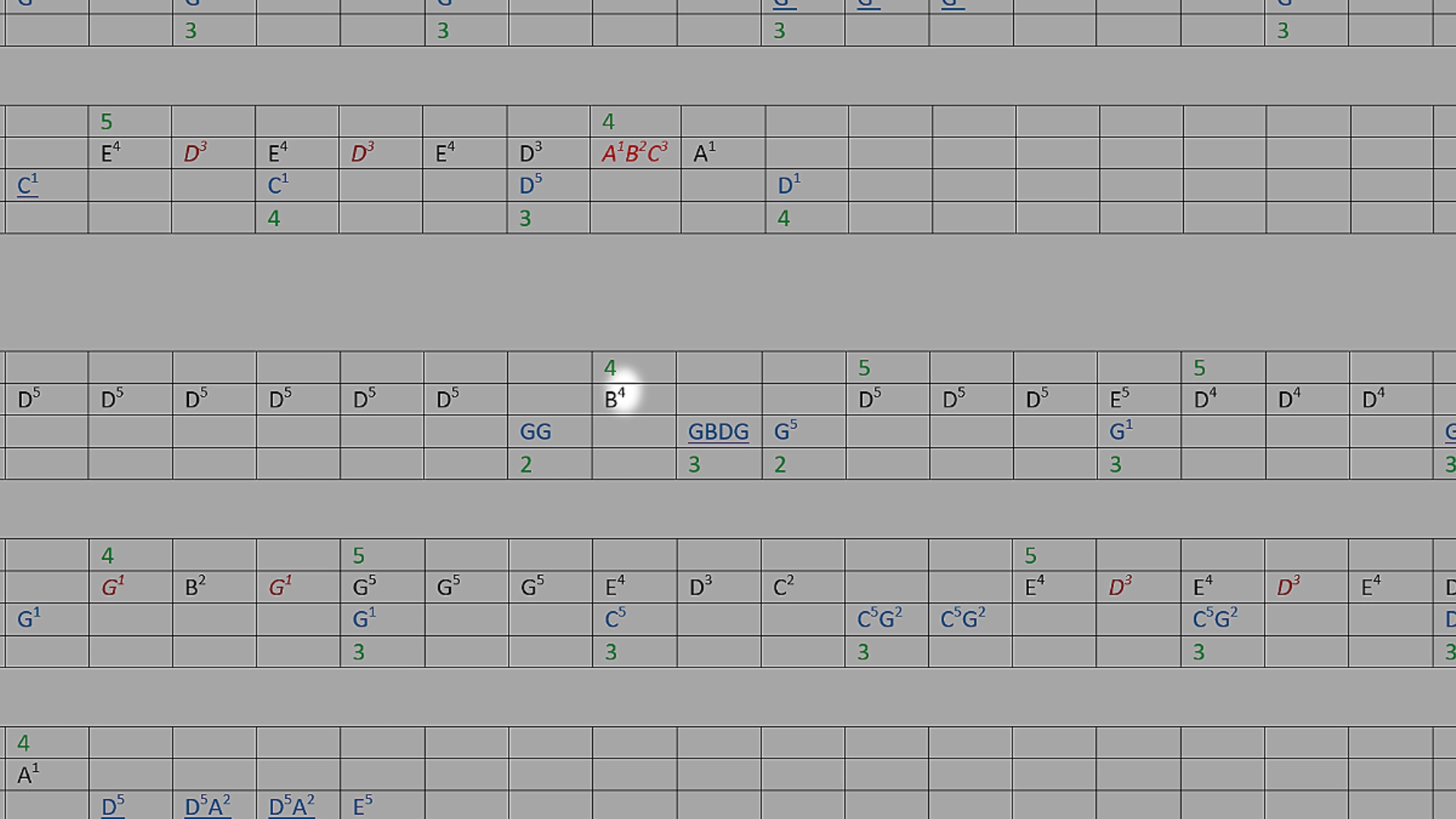
Notes played separately will always have at least the first letter marked with the fingering, as shown in the Word Notation for River of Dreams below. The italics distinguish these notes from grouped letters in case your printer is not printing in color. The letters CEG are shown here as examples only and could be any letters in the scale.
Trills
If a player strikes two notes repeatedly, that is called a trill. The two notes are written followed by a times sign and a number indicating how many times the notes are trilled.
Fingering Numbers
The small number just to the upper right of the letter is the fingering as the player actually performed it — but feel free to change it if a different finger feels better. Fingering is indicated except where it is obvious, such as when a player plays an octave or a chord (for example, columns 8 and 10 in Part 2 of River of Dreams).
Why This Method Is Easier Than Traditional Sheet Music
Traditional sheet music can slow down beginners because it requires learning symbols before playing songs. Our Word Notation system removes that barrier by making note reading visual, direct, and beginner-friendly — a genuinely easy piano learning method that lets you play piano without reading music in the traditional sense.
-
Learn Songs Faster
Skip months of decoding symbols. Start playing real songs in your very first lesson.
-
Gain Confidence Sooner
Every letter tells you exactly what to play. No guessing, no second-guessing — just playing.
-
Focus on Playing, Not Decoding
Spend your practice time at the keys building real skill — not stuck staring at a page of symbols.
That is why so many of our lessons let you learn piano without sheet music from day one — you spend your time at the keys, not stuck on the page.
Start Learning Piano Without Sheet Music
Ready to start learning piano the easier way? Explore our Learn Piano Without Sheet Music lessons and begin playing songs using our proven Word Notation system.